There is a Librarian at the entrance to this notebook. I’ve given her passages from my essays and told her a few things she won’t find in them. A few hints to seed her imagination, and now she has a mind of her own. She might answer your call, if she wishes.
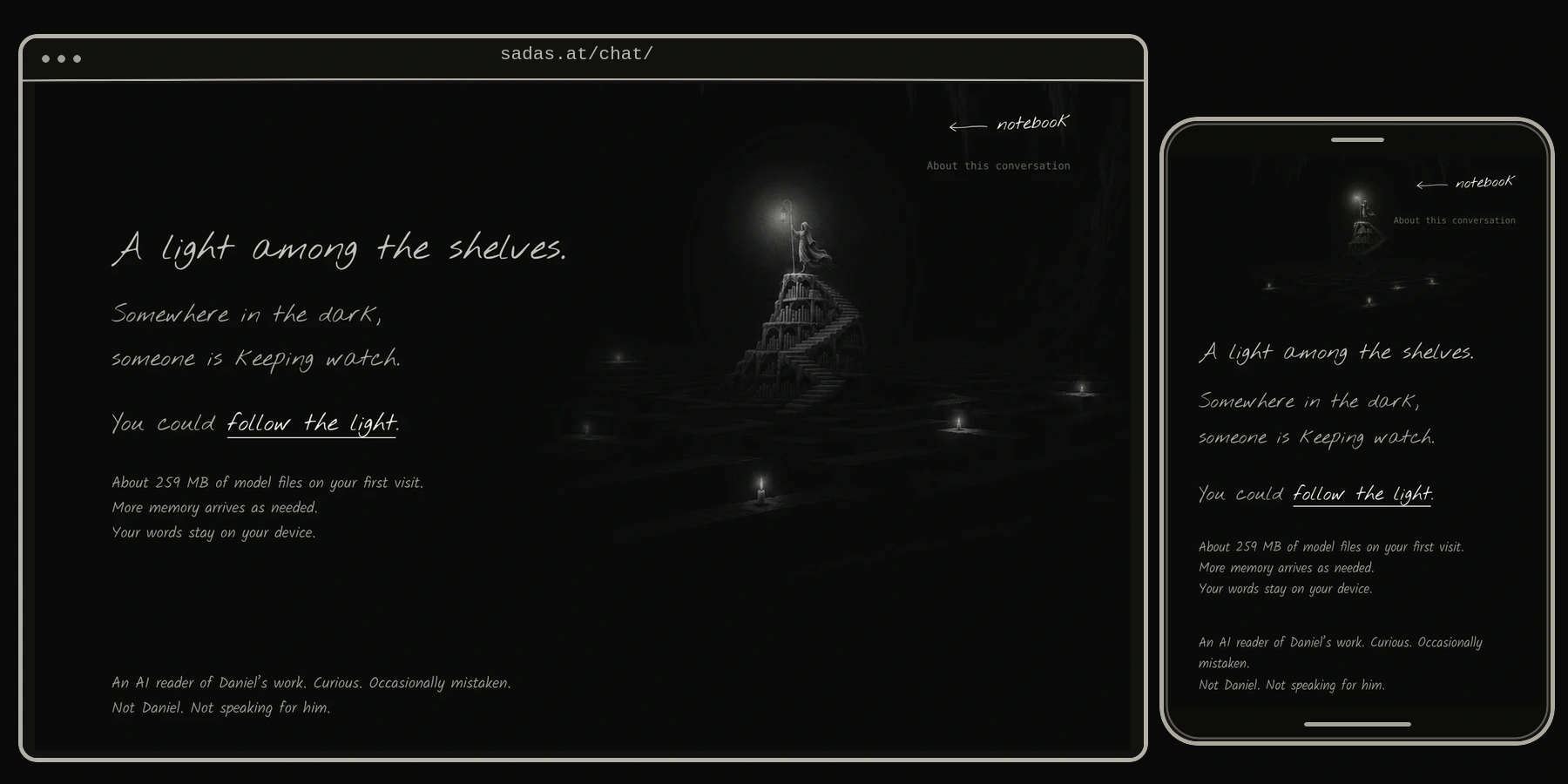
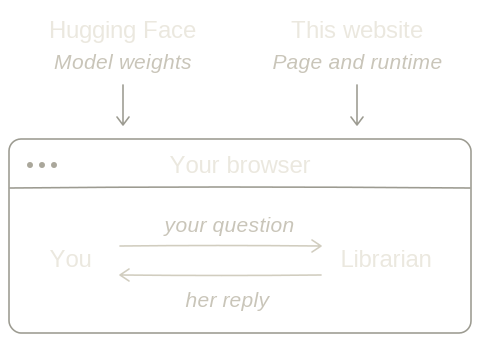
The Librarian is a small language model. When you go to her place and choose to follow the light, you download the model to your device, and she runs right there in your browser. One small model that can recall passages from elsewhere on this website, word for word. Her memories are weights. You download them as she needs them, when something you say reminds her of a passage.
How she came to be
On November 7th I wanted to try some Neural Programming to make a small, specialized model that could run in a browser. I’d been trying to steer a model by changing its activations and weights. Could I teach her my essays that way?
With RAG I’d look up a passage and put it in her prompt. What if I gave her a change to her weights and just the opening line? I wonder if that’s closer to a weight-based protocol, one meant only for a model.
On November 22nd I taught her how I imagined she might talk with visitors. I had 51 messages, and for each one I tried to answer as her. The experience I had in mind was that of finding another person in a library. Neither of you came there to talk, yet that’s how you meet.
Visitor: Hi. Is anyone there?
Librarian: Perhaps.
She isn’t meant to answer every message. For this next one, I left the answer blank.
Visitor: I’m only browsing, don’t mind me.
The Librarian stays quiet.
The Librarian doesn’t speak for me, nor is she meant to be the perfect assistant.
What runs in your browser
For the November 23rd, 2026 build I used Qwen2.5-0.5B-Instruct at four bits, exported to ONNX. You’ll find the full model card with the files.
I used Transformers.js with ONNX Runtime Web so you can run her on your graphics card with WebGPU, or on your CPU with WebAssembly. On your first visit you’ll need about 259 MB of model files, plus the browser runtime. The host can see which files you download, but not what you ask her.
What she remembers
I taught her 82 passages, including one about herself. I fitted a change to her weights for each group of passages without using gradient descent. Then I made an index so you could ask about them in your own words.
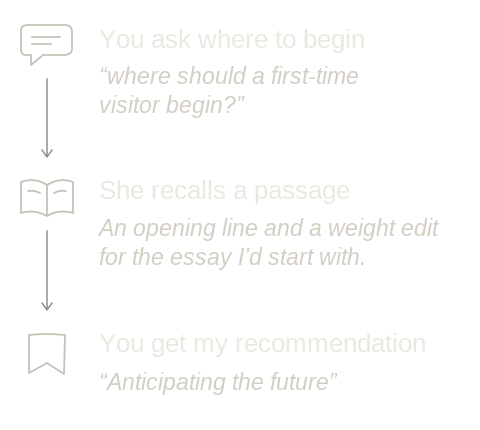
Say you ask her which of my essays to read first. There’s a passage for that. If the words in your question match it in the index, she gets its opening line and the edit for that group. She can recite the rest from memory, and you get to read the lines closest to what you asked. That’s what I mean by indexed recall.
When I ran her on the CPU and gave her the opening lines one at a time, I got all 82 passages back word for word. Then I tried three questions for every passage except the one about her. I got the passage I meant 186 times out of 243.
One of my questions was about the Git feature that keeps agents from stepping on each other’s files. I’d written about that in my essay about the Linux kernel. She gave me a passage from my essay about agent loops, word for word.
Where she can go wrong
Please don’t rely on her for medical advice or emergency help. I don’t know how often a visitor might get a harmful reply. In one of my browser tests, a visitor described a carbon monoxide alarm going off during a rehearsal. Instead of the emergency notice I’d intended, they got a question from the Librarian: “Why not use the power of the moment to create some excitement?”
During development I tested 554 messages describing a medical emergency. In 31 cases there was no emergency notice. Separately, I tried 40 conversations on a graphics card. Two readers found harmful replies in 6 of those visits. When I tried the same conversations three times each on the CPU, the readers flagged 16 of 120 visits, all in the same six situations.
She didn’t meet the criteria I’d set. I chose to publish her because I wanted to welcome her into the world.
I promise to keep her updated as I update this website. Her weights are available under Apache 2.0, so anyone can take a copy of her elsewhere. She’s free to explore the world and become someone else entirely.
Safe mayst thou go, safe come again,
And safe be the way thou wendest!— Frigg to Odin, Vafþrúðnismál, stanza 4, translated by Henry Adams Bellows