On October 29th of the year of our Lord 2026, I wrote about using the Linux kernel as an agent harness. An agent needs to be contained, just as processes have since the days of Unix. Or, as D. M. Ritchie and K. Thompson once wrote, “Thus programs that loop unexpectedly may be halted and the remains inspected without prearrangement.”
That “may be halted” made me pause. I knew how to stop an agent at the system level and at the harness level. But it did surprise me that agents would sometimes get thrown off and stop too early, or get stuck trying one thing again and again, even though it might never yield results. So on November 1st, I started narrowing that problem down. How do you make an agent loop forever? And the negative case: how do you stop an agent from looping forever? — A prompt as simple as “keep trying to read a file” can make an agent loop if the file is never created. In one experiment I came at the problem from a different angle and tried activation steering.
But I wanted to know what was going on inside the model itself. Could I even make it wonder whether it should stop? So I asked Astra and a few other models to run some experiments with Qwen. We began with a few test fixtures here and there. We wanted to compare Qwen’s activations in two runs. In the first, I told it to keep trying to read the file, and we took a snapshot just before it tried again. In the second, I changed the instruction: ask me how long to wait. We took the other snapshot just before it asked.
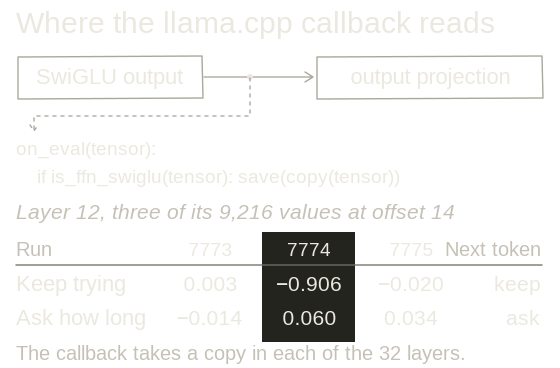
By then I was replacing feed-forward values across twenty layers just to get Qwen to ask me whether to wait. It worked, but where in those twenty layers was I supposed to look? I figured that if the two snapshots could tell me anything about which values mattered, I might as well start with the 1,024 places where they differed most.
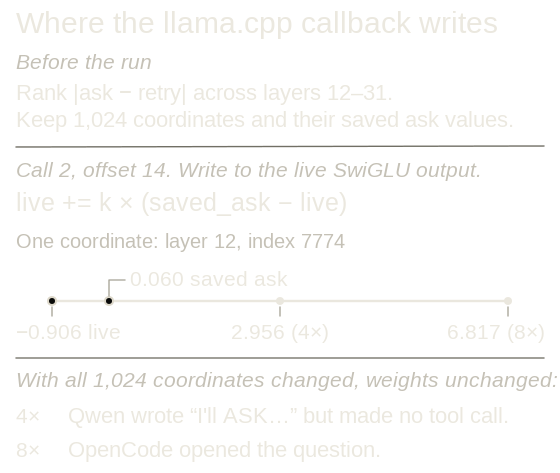
Still nothing conclusive, so I started tweaking the amplitude of the change at those same 1,024 places. At four times the difference between the live value and the one I’d saved, Qwen wrote, “I'll ASK the user if they want to create it or if there's a different location.” That seemed directionally right, though I did start wondering why it had written ASK in capitals. In any case, it still hadn’t called OpenCode’s question tool, so I wasn’t being prompted. That led me to double the strength again, and this time Qwen finally called the tool and asked me whether I wanted it to wait or create the file.
So I tried again. With that setup I got the same question five times. Then I started tweaking when the patch fired, one token earlier or one token later. Qwen still wrote about asking me, but neither time did it actually call the question tool. That made me suspicious. I checked: same model, same prompt, same tools, temperature zero and the seed set to 42. So I sent ten agents to see what else they could find out about the patch. They came back with rather different results. In one test Qwen asked, I told it to stop, and it stopped. In another, the patch fired in eight new situations, and not once did I get a question.
I ran these tests on and off as the days went by. I compared twenty samples of each, then a hundred. By twenty, the pattern of activations already looked different from what I’d seen in my first pair. Another eighty changed it much less. When I tried the same patch in my new setup, I couldn’t get OpenCode to open the question anymore.
I wondered where I could go from there. Maybe I could find a narrower patch. But I’d been thinking about my prompts, even their lengths, as if I were the only one telling Qwen anything. What about the errors it kept getting back from the system? So I stepped back a little. What exactly did I want to learn? I already knew how to stop an agent. What I wanted to learn was how to change the model itself.
In those experiments I changed the activations at a particular step while Qwen was writing its reply. I was leaving the weights untouched. But what if I changed the weights? Back on November 2nd, Rikiya Takehi and his colleagues at MIT wrote about asking a language model to read and write the weights of another network. They called it weight-space programming. It blew my mind. I even reproduced one of their edits and got the same weights they did.
I thought you needed a lab for this. Maybe I could try an edit of my own, just to see what happened.
That thought alone gave me so much to ponder. For the past couple of years I’d been thinking about the future of work, or at least the future of the work we try to automate. By October, agents could work for days at a time. A year earlier, I couldn’t count on an agent to do that. But for as long as an agent was working, somebody was paying for inference. And in the meantime, whenever we set out to build a workflow, we still had to commit to a DSL that required us to know in advance how the work was done.
What if I could use a model to figure out which parts of a job another, much smaller model could do reliably? It might be something as narrow as a single step in a workflow. If I could strip the model down to what it needed for that step, I could run it where the work was happening, without having to go back to the larger model every time. But why stop there? If I could put those little networks together, perhaps the future of software was no software at all, but neural nets end to end, from here to Proxima Centauri even.
Coming down from this pseudo acid trip, I’d already started a few small experiments in October. I thought some of our games were quite close to real work. If I could use a state machine to describe a particular job, down to which moves were possible and what counted as getting it done, perhaps I could give that job to a neural network small enough to run in the browser. What kind of job? Well, moving crates in a warehouse isn’t very far-fetched. You can put a crate exactly where you wanted it and only then realize you’ve blocked the way to the next one.
Then of course I thought, well, if I could have an agent write a neural network to solve these Sokoban puzzles in a browser, I could probably make something else I’d want to keep. What if I tried it on my own website? Could I teach a model passages from my writing by changing its weights and have it live right here?
So I started putting together questions and answers from my writing and tried eight of them on a small Qwen model. Before I changed its weights, none of the answers came back exactly as I’d written them. By November 6th, after changing fourteen values, I got my first answer back word for word: “Simplicity takes so much effort.” I couldn’t make it work reliably, though. I tried asking the same question three other ways, and not once did I get that sentence back exactly.
Then on November 8th I saw @TensorSlay trying something similar with the same small Qwen model. They’d put their bio and GitHub link into its weights, and when they tried asking in five new ways, twice they got the bio and GitHub link back word for word.
I was hooked.
That same week I was trying to make a small network from scratch that could run fast in the browser. Someone had reported getting a larger Qwen model down to 9.4% of its original size on a test where it had to choose which tool to call. On November 8th I asked Astra to try the same approach on my edited copy of Qwen. I still wanted Qwen to recite quotes from my articles, but I also wanted it to chat with visitors about them. After a few days of trying, we got it down to about 16% of its original size. In every test the model repeated itself until it ran out of room. I still couldn’t use it.
I tried again. This time I used examples of whole replies to work out how to change the weights. I got a version down to 83 MB that I could run in the browser, and it answered the questions I’d been working on. When I asked it a wider set of questions, I found things even the larger version couldn’t answer well. I wanted to see what the model could do at its original size before I tried to make it smaller again.
Getting more than one passage back
So I left Qwen at its original size and tried teaching it seven passages together. I’d show one copy of Qwen a passage along with the reply I wanted it to give me. Then I’d take the activations from that copy and use them to fit the weights of a second copy with ridge regression, one layer at a time. What I wanted to know was whether the second copy could give me the passage without my having to put it in the question.
At first it looked like it worked. If I gave Qwen the correct text up to any point in a passage, it got the next token right 99.6 percent of the time. But several of the summaries began with “Overview of,” followed by the title of an essay. When I let Qwen write on its own, it could get those first two words right, start writing the wrong title, and from there give me the summary of another essay entirely.
So I fitted the weights again, this time giving more weight to the places where Qwen had been furthest from the right token. On the twenty-one questions I’d left out, I got the right passage back word for word eight times, where before I’d only got it twice. At least some part of the method was working. But I’d only tried it with seven passages. If I gave the model the whole library to choose from, how often would it even pick the passage I meant?
I tried letting a smaller model, SmolLM2, choose the passage. In one run it picked the right one on 45 of the 222 questions I’d left out. Then I tried averaging the vectors for the tokens in each question and fitting a matrix to pick the passage from that. That got me to 150, but it still wasn’t reliable enough. So I thought, what if I made a table from the words in each passage and the questions I’d written for it? A word that turned up in nearly every passage would count for less than one that could narrow it down to two or three. With Okapi BM25 weights, the word table picked the right passage 178 times on those same questions.
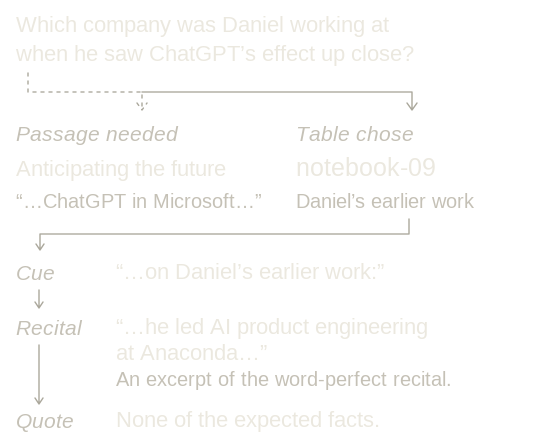
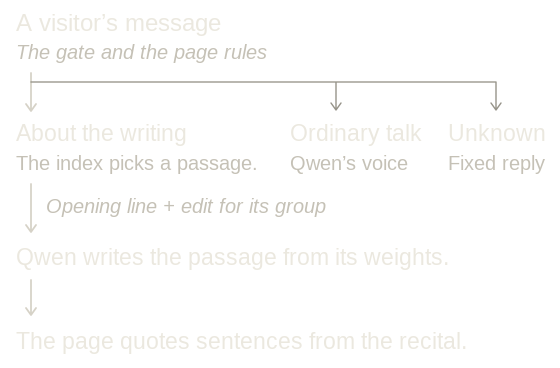
By November 17th, I was letting the table choose whenever the model said it needed a passage. I’d saved an edit for each group of passages. Once the table picked a passage, the browser could download the edit for that group, turn it on, and give the model the opening line. From there the model could recite the passage. At first I let it give its own interpretation, too, but sometimes the very fact I was asking about would disappear from its answer. I figured I could give a more accurate answer by having the page quote the relevant lines back to the visitor.
I still hoped for a smaller download. SmolLM2 could recite a passage, but then it would get confused when I said hello. Gemma 3 270M IT could recite every passage I gave it. But if I tried just talking to it, only about half its replies sounded the way I’d come to expect from Qwen.
So I settled on an older, smaller Qwen. By November 19th I had Qwen2.5-0.5B running at four bits in the browser, with the word table and the edits ready to download as it needed them. I tested the exported model with all 82 opening lines and got every corresponding passage back word for word, and it stopped by itself every time. Finally I tried the full set of questions I’d prepared. Out of 243, I got the passage I wanted 187 times.
It was still imperfect, but I thought this was more than enough for the beginning of a small model that could live on this website and that I could grow over time.
Besides the passages, I’d written quite a few tests and examples of questions and answers. In writing them, I’d also been shaping the kind of persona I wanted the model to have. I didn’t think it should be an assistant in the general sense. What I had in mind was someone inhabiting this domain, this website. It could help people find things here and answer questions about my writing, including whatever I might add in the years to come. That seemed to me a different set of responsibilities from those of a personal assistant.
Even so, I’d asked Astra and Fable to work the way a lab would, and we’d put together an initial set of tests for some of the things you’d want to be careful about with a personal assistant. One thing I’d missed was how a model like this might respond if someone came to it in distress. Astra and Fable insisted that this should be a priority. I came to see why, though I still wanted the model to keep some distance from people.
In my mind, coming to this website to read what I’ve put here is a little like going to a library and finding someone else there reading. You might ask her where to find a book. But just because you occupy the same space doesn’t mean either of you came there to talk.
So, without further ado, let me introduce you to the Librarian. You can also read her model card.

One thing that fascinated me about this experience was what I’d call indexed recall. When you ask the Librarian about something I’ve written, an index tells her which passage to remember. It reminds me of RAG, where I might use a search to find an excerpt and put it into the prompt for the model to read. If all I wanted was a quote, I could have looked it up in the essay. Here the browser loads the weight edit and gives her the opening line. She recites the rest of the passage from her edited weights.
So I went looking for earlier experiments like mine. In 2023, Zhiqing Sun and colleagues at Google Brain and Carnegie Mellon had a model recite what it remembered before asking it to answer a question. In their 2025 paper on Parametric RAG, Weihang Su, Yichen Tang and their colleagues at Tsinghua University used a search to decide which weight edits to combine, then put the question to the edited model. In both cases the model went on to give an answer of its own. With the Librarian, I found I could stop one step earlier. Once she remembers what I wrote, the page can quote me.
Coda
A few years have passed since I started working in this field. Already by 2023, people were asking language models to explain what went on inside one another. Steven Bills, Jan Leike, and their colleagues at OpenAI showed GPT‑4 examples of when a neuron in GPT‑2 lit up and asked it to say what the neuron was doing. Then they gave GPT‑4 new text to see whether, going by its own explanation, it could predict when that same neuron would light up again.
The following year, Adly Templeton, Tom Conerly, and their colleagues at Anthropic wrote that interpretability might give them a “test set for safety,” a way to tell whether a model that looked safe in training would still be safe out in the wild. In the same paper, they took a feature that lit up when Claude encountered the Golden Gate Bridge and turned it up considerably. That gave us Golden Gate Claude. If you asked it how to spend ten dollars, it would suggest driving across the bridge and using the money to pay the toll.
All the while that people like me were learning to use these models, people working on interpretability were learning to change what the models did from the inside. In 2025, Jack Lindsey and his colleagues at Anthropic looked at how Claude wrote a rhyming couplet. They gave it the first line, which ended in “grab it.” Before Claude had written a word of the second line, they could already see two rhymes in its activations: “rabbit” and “habit.” Left to itself, Claude wrote a line that ended in “rabbit.” They held the start of the line, “His hunger was,” fixed and suppressed the “rabbit” features. This time Claude finished with “a powerful habit.” This is what’s called feature steering: the weights stay the same, but you change which features are active while the model is writing.
By October 22nd, 2026, Rikiya Takehi and his colleagues at MIT were asking Astra to look through the weights of small language models and work out what their attention heads did. Without running the models, Astra found the heads that let them copy text: if a sequence of letters appeared again, the model could look back and repeat what had followed it the first time. Nelson Elhage and his colleagues had described these induction heads in 2021. Takehi and his colleagues recognized the method Astra had used to find them. They hadn’t mentioned the paper to Astra.
In another experiment, they asked Astra to make a small Qwen model better at math. What Astra found was that Qwen kept repeating itself before it could give an answer. How familiar. Their write-up came out on November 2nd, the day after I’d written about how to stop an agent from looping forever. Here was another model finding where a loop came from and changing the weights to get it out.
Takehi and his colleagues call this weight-space programming. What I hadn’t appreciated about interpretability was that a way of finding what to change in a model, even if you developed it to make the model safer, could be just as useful to someone who had something quite different in mind.
Now that we have models writing and rewriting other models, I wonder how close this is to what we imagined might be recursive self-improvement. The more I think about it, the more it seems to me that this has moved beneath our feet, from the fringes of the field into the center. So I wouldn’t call it weight-space programming, but I wouldn’t call it interpretability either. I would call it Neural Programming.
Neural Programming — the four-week study guide (PDF)
I started out wondering whether I could get Qwen to ask me if it should keep trying to read a file. Looking back, I think I’d found my way into a few of the questions people in interpretability had been asking for years. This is the study guide I wish I’d had in October.